
When a highway project has to cross a marsh, or a housing development sits next to a swamp, the work doesn’t just stop. But it doesn’t proceed without accountability either. Federal law requires developers to address the damage – not just acknowledge it. That requirement is what wetland mitigation is: a system that says if you harm a wetland, you have to make up for it somewhere else.
The principle is simple enough. The execution is not. Getting a project approved, building something that actually functions as a wetland, and keeping it healthy for years afterward requires scientific knowledge, engineering, and ongoing oversight. This guide explains how the system works and why it exists.
Understanding Wetland Mitigation: Core Concepts
The wetland mitigation definition is straightforward: compensating for damage to a wetland by restoring, creating, improving, or protecting another one. You impact one area – you pay that debt back somewhere else.
The legal framework behind this is the Clean Water Act, which classifies wetlands as “waters of the United States.” Filling or draining them requires a permit from the Army Corps of Engineers. That permit almost always comes with a mitigation requirement.
Regulators enforce a specific sequence before mitigation even comes into play:
- Avoid first. Can the project route entirely avoid the wetland? If yes, it has to.
- Minimize the second. If avoidance isn’t feasible, can the footprint of impact be reduced? It must be.
- Mitigate what’s left. Only after those steps are addressed does wetland mitigation kick in to compensate for any remaining harm.
The goal behind all of this is “no net loss” – the country shouldn’t end up with fewer functioning wetland acres after development than before it. Wetlands filter water, absorb floodwater, store carbon, and support wildlife. Losing them quietly, one project at a time, costs more than the accounting usually shows.
Types of Wetland Mitigation
There are four recognized methods, and the right choice depends on the site, the ecology, and the requirements of the permit.
- Restoration. This is the restoration of a degraded or former wetland. A farm field that was drained decades ago has its drainage tiles removed, and water is allowed to return. It’s the preferred approach because the soil and seed bank are often still there – nature does most of the work once hydrology is restored.
- Creation (Establishment). Building a wetland where none existed before. This is the hardest method. Soil needs to be graded to retain water, native plants need to be established, and water levels need to be carefully managed until the system stabilizes. Success rates are lower than restoration, which is why it’s not the first choice.
- Enhancement. Improving an existing wetland that’s functioning but degraded. Removing invasive species that are crowding out natives, increasing water depth in a drying pond, and adding buffer plantings – these make an existing area more productive without starting from scratch.
- Preservation. Legal protection of a high-quality wetland that faces future development risk. No new acreage gets added, but a site that might otherwise disappear gets permanent protection. Used less often because regulators want functional gains, not just protected acreage.
Most real projects blend these methods. A single mitigation site might involve restoring one section, enhancing another, and preserving a third. The combination depends on the site’s needs and the permit requirements.
Developing a Wetland Mitigation Plan
A wetland mitigation plan is a legally binding document that must be approved before construction begins. It’s not optional, and it’s not general – it describes exactly what will be done, where, and how success will be measured.
The process starts with a detailed site assessment. Scientists walk both the impact site and the proposed mitigation site, recording plant species, soil types, and hydrology. Understanding what’s being lost at the construction site tells you what you need to replicate or offset elsewhere.
The plan design follows from that data. It includes grading maps showing where water will pool and drain, lists of native plant species to be installed, and specifications for any earthwork or water control structures. Nothing gets left vague – the document has to be specific enough that a monitoring ecologist can evaluate it years later.
Success criteria are written into the plan upfront. These are measurable targets: a certain percentage of planted species surviving after three years, specific water depths maintained throughout the growing season, and defined coverage of native vegetation. If those targets aren’t met, the developer is responsible for corrective action.
Monitoring typically runs for five to ten years after construction. Ecologists visit the site regularly – at a minimum annually – and submit reports to regulatory agencies. If the mitigation site isn’t developing as planned, the developer has to fix it. The obligation doesn’t end at planting.
Ecological Benefits of Wetland Mitigation
The ecological benefits of wetland mitigation go beyond satisfying a permit requirement. When these projects are done well, they create functional ecosystems that provide real services.
- Flood control. Wetlands hold water. During heavy rain events, they absorb runoff that would otherwise flow rapidly downstream, thereby raising river levels. Communities near restored wetlands often see reduced flooding, as shown in insurance data, not just in ecological reports.
- Water filtration. Water moving through a wetland slows, and as it does, plants and soil filter out nutrients, sediment, and contaminants. Phosphorus and nitrogen from farm runoff – which cause algal blooms in downstream water bodies – get captured and stored. The filtration that happens in a functioning wetland would cost significant money to replicate mechanically.
- Wildlife habitat. Wetlands are disproportionately important to biodiversity. A large percentage of threatened and endangered species depend on them for some part of their life cycle. Restored and created wetlands – especially when they’re connected to other natural areas – function as corridors that allow populations to move and survive.
- Carbon storage. Wetland soils accumulate organic matter over time and store it in conditions that prevent decomposition. This makes them effective carbon sinks. Protecting and restoring them is increasingly recognized as a cost-effective climate tool alongside reducing emissions.
The ecological return on wetland mitigation depends heavily on how well the project is executed. A poorly designed mitigation site that fails to establish functioning hydrology fails to produce any of these benefits. Quality of implementation matters as much as the acreage numbers on paper.
Choosing Wetland Mitigation Services
The regulatory requirements are specific, the science is specialized, and the permit conditions are legally enforceable. Most developers don’t navigate this alone. Wetland mitigation services are specifically designed to handle the permitting, planning, construction, and monitoring required by the process.
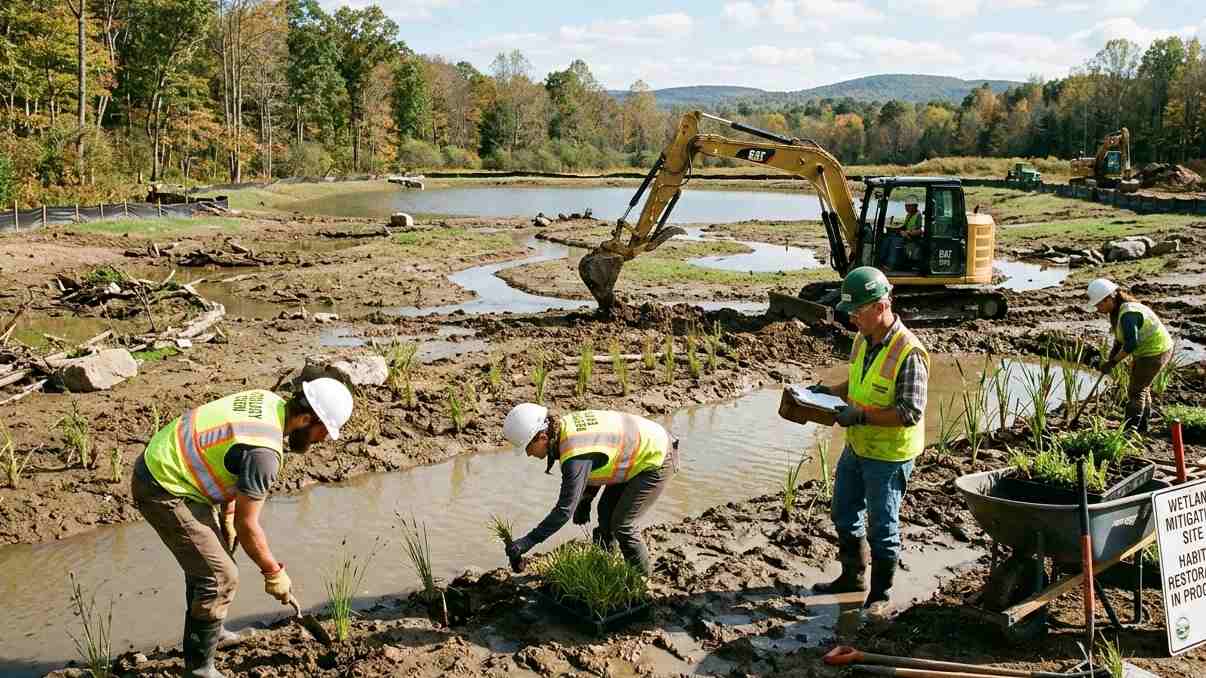
When evaluating wetland mitigation services, track record matters more than anything else. You want a firm that has gotten plans approved, built sites that passed monitoring, and dealt with the same regulatory agencies you’ll be working with. Local experience matters – the right firm understands the specific plant communities, hydrology, and regulatory staff relevant to your project.
A good service provider also understands the concept of mitigation banking. In many cases, buying credits from a permitted wetland bank – a large, professionally managed mitigation site with credits available for purchase – is more efficient. It produces better ecological outcomes than buying credits from a small, project-specific site. The right firm will know whether banking makes sense for your situation and help you find the right bank.
One option worth understanding: the mitigation bank model puts the responsibility for success on the bank operator, not the developer. Credits are only sold after the bank site has demonstrated performance. For developers who don’t want years of monitoring obligations, this is often a cleaner path.
Whatever approach fits the project, professional guidance keeps the process on track – from initial permit application through final monitoring sign-off.
Timelines are another reason to bring in experienced help early. Permit review by the Army Corps of Engineers and state agencies can take months. If mitigation planning starts late – after design is already locked in – the project schedule gets compressed in ways that are expensive to recover from. Firms that have been through the process know what information agencies need upfront, which questions will come back during review, and how to respond without losing weeks. Starting the environmental work in parallel with early design, rather than after, is usually the difference between a project that moves and one that stalls.
Cypress Engineering provides environmental consulting and wetland mitigation support for infrastructure and development projects. Get in touch to discuss what your project requires.