
Before any building goes up, someone has to figure out what’s actually going on underground. That part of the job, the part most people never think about, falls to geotechnical engineering. Put simply, it’s the branch of civil engineering that deals with soil, rock, and groundwater, and studies how these materials hold up when you start putting structures on top of them.
The reason this matters more than people realize: ground that looks perfectly fine from the surface can behave in unexpected ways under load. Wet clay compresses. Sandy soils shift. Some materials expand when they absorb water, cracking whatever’s sitting above them. And none of this shows up until it’s too late – unless someone checks first. That’s exactly the problem this discipline exists to solve, and it does so long before the first shovel breaks ground.
What makes geotechnical engineering genuinely distinct from other branches of civil engineering is the level of uncertainty involved. Structural engineers work with materials that come with datasheets – steel has known strength, and concrete has known behavior. Soil doesn’t. Every site is different, and the only way to know what you’re dealing with is to go and find out.
Geotechnical Engineering: Definition and Core Principles
At its core, geotechnical engineering is about understanding how earth materials respond to pressure. It pulls from geology, physics, and hands-on engineering practice – three things that rarely travel together, which is part of what makes this field genuinely interesting.
Geology tells engineers how the ground was formed and what layers likely exist beneath the surface. Physics provides the math to calculate how stress moves through those layers. Engineering translates all of that into decisions: what to build, where to build it, and how deep to go.
No two sites are identical. The soil under one block of a city can be completely different from what’s sitting two streets over. Glacial deposits, old riverbeds, filled land, and weathered rock – all of these can exist within the same project boundary, and each behaves differently under load. That’s why geotech engineering can’t rely on generic assumptions – every project needs its own investigation. Skip that step, and you’re essentially building on a guess. Sometimes the guess works out. Often enough, it doesn’t, and the consequences show up years later when they’re hardest to fix.
What Does a Geotechnical Engineer Do?
What does a geotechnical engineer do on a typical project? The short answer is: a lot of things that happen before anyone else even shows up on site.
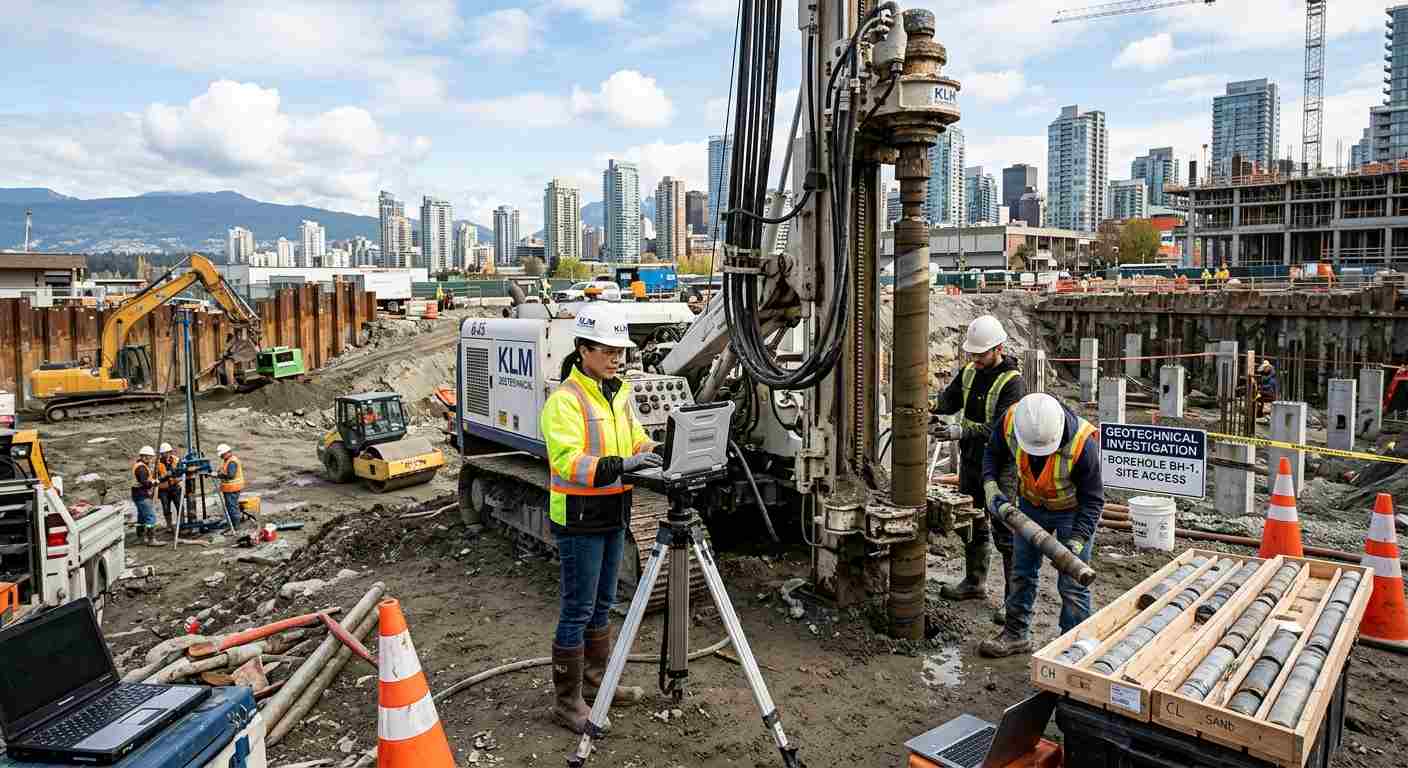
The work starts in the field. Engineers drill boreholes, collect soil samples at different depths, and run tests in situ to measure the resistance of the layers. Then those samples go to a lab, where the real analysis begins – checking moisture content, density, how quickly water moves through the material, and critically, how much force the soil can take before it fails.
After that comes the desk work, the soil engineer takes all those numbers and turns them into guidance the project team can actually use: which type of foundation to specify, how much load the ground can realistically carry, and whether the soil needs treatment before construction starts. This reporting stage matters more than people outside the industry tend to appreciate. A geotechnical report isn’t just a formality – it’s the document that every downstream decision gets anchored to, from structural design to construction scheduling.
They stay involved through design and often through construction too, working alongside structural engineers to make sure nothing gets lost in translation between what’s underground and what’s being built above it. When unexpected conditions turn up mid-construction – and they sometimes do, even on well-investigated sites – it’s the soil engineer who figures out what it means and what to do about it.
Soil Mechanics and Site Investigation
Soil mechanics treats dirt as an engineered material – something with measurable properties that behave predictably under the right conditions. A soil engineer working on a site investigation is essentially building a picture of the ground from the inside out.
The key properties they’re looking for: how much water is trapped in the soil, how dense and tightly packed it is, how easily water drains through it, and, most importantly, its shear strength. That last one tells you how much lateral force the soil can resist before it slides or collapses.
Field methods vary depending on the project. Borehole logging involves drilling down and pulling up intact cores for direct examination. The Standard Penetration Test (SPT) drops a weighted hammer repeatedly to measure the resistance to penetration. The Cone Penetration Test (CPT) pushes a sensor down at a steady rate and continuously records resistance. Each method gives a slightly different picture, and experienced teams often use more than one.
Laboratory testing adds another layer. Samples collected in the field get subjected to controlled conditions back at the lab – compression tests, permeability tests, consolidation tests – to build a more complete picture of how the soil behaves over time and under sustained load. The combination of field and lab data is what makes a geotechnic investigation genuinely reliable.
The value of getting this right is hard to overstate. A soft clay layer found during initial testing is a design input. The same layer discovered mid-construction is a crisis, often an expensive one.
Foundation Design in Geotechnical Engineering
Once the ground is understood, the next question is how to connect the building to it. That’s foundation design, and it’s where civil geotechnical engineering directly intersects with structural work.
The basic split is between shallow and deep foundations. Shallow systems – spread footings, mat foundations – sit close to the surface and work well when the upper soil is strong enough to support them. Deep systems (piles, drilled shafts) push the load down past the weak surface layers into competent material below, sometimes to depths of 30 meters or more.
Choosing between them isn’t just about whether the soil can hold the load. Settlement matters too. Almost every building sinks a little over time – that’s normal. What causes problems is uneven settlement, where one part of the foundation drops more than another. The geotech engineering team has to predict the likely amount of movement and ensure the design can accommodate it without cracking walls or breaking connections. In some soil types, particularly soft clays, settlement can continue for decades, requiring the analysis to extend well beyond the construction period.
Slope Stability and Earth Retaining Structures
Flat sites are straightforward. Slopes are not.
Any time a project involves cutting into a hillside, grading an embankment, or building near a steep face, the team needs a proper slope stability analysis. This means identifying where the most likely failure surfaces are – the planes where the soil is most likely to shear and slide – and calculating a factor of safety to confirm that the slope can withstand realistic conditions, including heavy rain and seismic loading.
When natural slopes aren’t stable enough on their own, retaining structures take over. Gravity walls use their own mass to hold back the earth. Cantilever walls work more efficiently with a hidden footing buried below grade. Sheet piles are driven into the ground in tight spaces where there’s no room for a wide base. MSE walls build up slopes in layers, using reinforcing grids to hold the fill in place. Each solution has its appropriate context, and part of the geotechnic engineer’s job is knowing which one fits.
These aren’t minor elements; they protect highways from rockfall, keep railway lines clear, and prevent hillside neighborhoods from sliding after heavy rainfall. Good design here directly affects public safety in ways that rarely get attention until something fails.
Geotechnical Hazards and Risk Assessment
Some of the most dangerous ground conditions are invisible until something goes wrong. Liquefaction is a good example: loose, saturated sand that behaves like a solid under normal conditions can lose all its strength during an earthquake and flow like a liquid. Buildings on liquefied ground don’t just crack – they can sink or tip entirely. This phenomenon has caused catastrophic damage in major earthquakes across Japan, New Zealand, and Turkey, and it’s entirely predictable when the right investigation is done upfront.
Other common hazards include expansive soils that swell after rain and crack foundations from below, landslides triggered by saturation or slope disturbance, and erosion that quietly undermines structures over the years. Civil geotechnical engineering addresses all of these through a risk assessment process that identifies what’s present and designs mitigation accordingly. That might mean ground improvement – compaction, grouting, stone columns – or redesigning the project layout to avoid the worst areas altogether. The earlier these decisions get made, the cheaper and more effective the solutions tend to be.
Why Geotechnical Engineering Matters for Your Project
Owners who cut corners on subsurface investigation usually end up paying far more later. Foundation repairs after construction is complete are expensive. Legal disputes over structural failures are worse. And some problems – a building that’s settled unevenly, a retaining wall that’s shifted – simply can’t be fixed cleanly after the fact.
| Project Stage | Geotechnical Action | Value Delivered |
| Early Planning | Site history & preliminary borings | Avoids buying problematic land |
| Detailed Design | Full lab testing & pile analysis | Optimizes foundation, reduces material costs |
| Construction | Compaction testing & inspection | Verifies ground conditions match the design |
The math is straightforward: a proper investigation at the start costs a fraction of what remediation costs later. Bringing in a qualified civil geotechnical engineering team early means the project is designed around actual conditions, not assumptions. The foundation type is optimized, material quantities are reduced, and surprises don’t ambush the schedule. It’s one of those investments that doesn’t look impressive on a budget line – until you see what happens on projects where it was skipped.