A watershed management plan is a written account of how a drainage basin actually works and what the sponsors will do about the problems in it. Land use, hydrology, flooding, sediment, and pollutant sources get described and analyzed. Then the plan ranks projects, names a funding path, and sets a way to check whether those projects work after they go in the ground.
This page is about the document. The service is Watershed Management Plans.
What is usually in one
- Characterization. Topography, soils, land cover, channels, outfalls, wetlands, and who owns the ditches.
- Data. Flow, stages, water quality, flood complaints, existing models.
- Problems. Where it floods, where it erodes, what is in the water, and what a future land-use map will do to the hydrograph.
- Actions. Storage, conveyance, source control, restoration, ordinance changes — ranked, not wished.
- Money and monitoring. A plan with no funding path is a brochure.
EPA and the Gulf states each have planning outlines when federal or state money is involved. Use the outline the sponsor’s funder asked for. Do not invent a fifth framework.
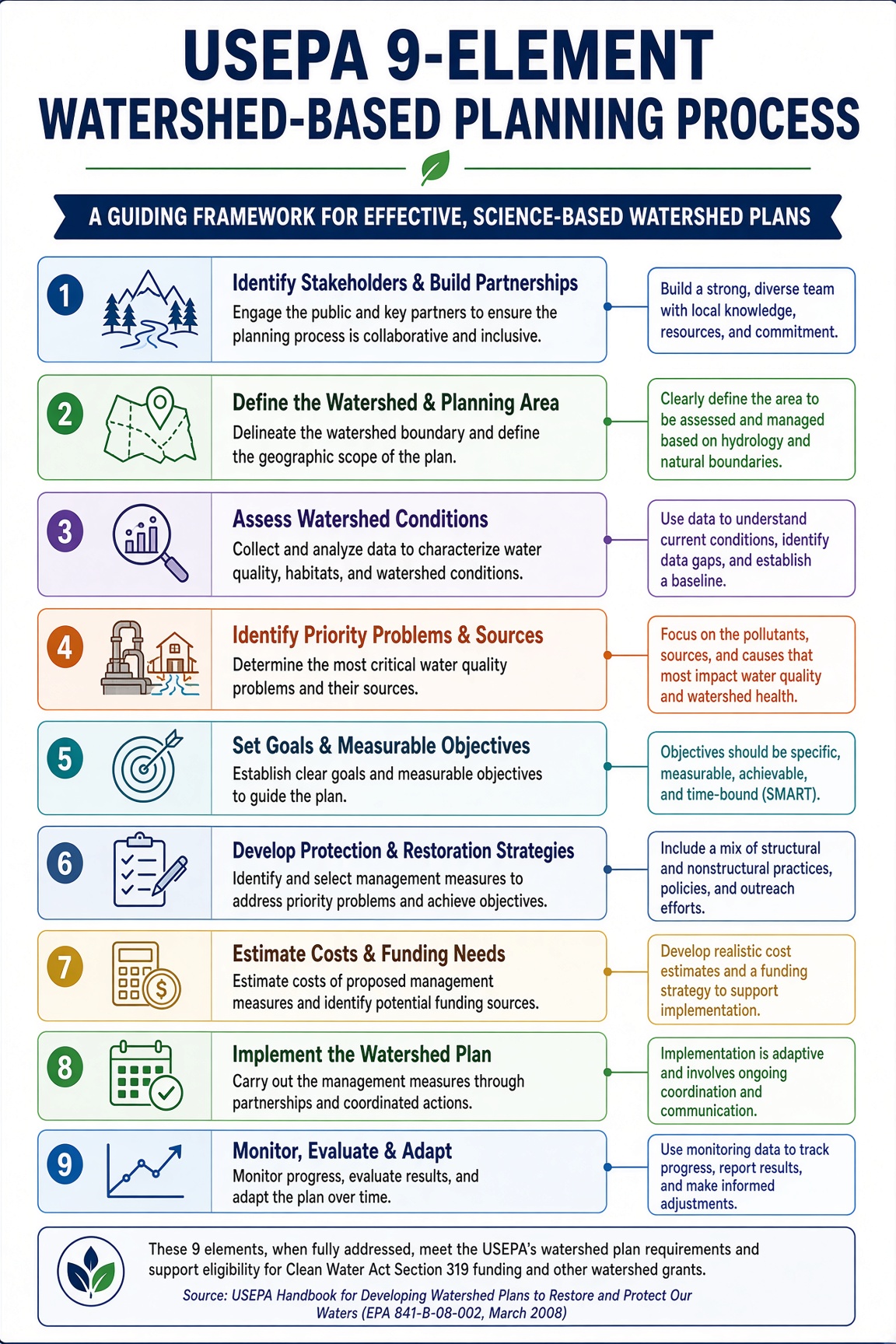
The USEPA nine-element watershed-based plan
When Clean Water Act Section 319 money is on the table, EPA does not treat “watershed plan” as a generic phrase. It means a watershed-based plan that addresses nine minimum elements. EPA laid those elements out in the Handbook for Developing Watershed Plans to Restore and Protect Our Waters and restated them in the Section 319 grant guidelines, including the 2024 update.
Alabama, Mississippi, and the other Gulf states use that same checklist when they pass 319 funds to cities, watershed groups, soil and water districts, and nonprofits. ADEM will not treat a 319 implementation proposal as complete unless the underlying plan hits the nine elements or an EPA-acceptable alternative. MDEQ builds the same requirement into its watershed-based plans and Watershed Implementation Teams.
The first three elements diagnose the basin and set the load target. The last six turn that diagnosis into a schedule someone can fund and audit.
- Causes and sources. Name the impairments and the pollutant sources that have to be controlled, at a useful subcategory level — acres of uncontrolled runoff, miles of failing bank, number of failing septic systems — not a paragraph that says “urbanization.”
- Load reductions. Estimate current loads and the reductions the selected measures should produce. Use the TMDL where one exists. A rough estimate is acceptable where one does not. Do not pretend the number is more precise than the data.
- Management measures and critical areas. Describe the practices that will produce those reductions and map where they have to go. Practices without a critical-area map are a wish list.
- Technical and financial assistance. Estimate costs, name authorities, and list the funding sources the sponsors will actually pursue. Include operations and maintenance, not just construction.
- Information and education. Say who has to understand the plan and how they stay in the work after the kickoff meeting.
- Schedule. A reasonably expeditious timeline for the measures in the plan.
- Milestones. Interim, measurable checkpoints that show whether practices are going in the ground on time.
- Criteria. Indicators that tell you whether load reductions and other goals are being met, and when the plan needs to change.
- Monitoring. The sampling and assessment program that feeds those criteria. No monitoring plan means no way to prove the work did what the grant promised.
That is why a nine-element plan is not extra paperwork on this coast. It is the format Section 319 reviewers already use. It also travels. A plan that already names sources, reductions, critical areas, costs, milestones, and monitoring is easier to lift into a Clean Water SRF package, a RESTORE or NRDA proposal, or a FEMA mitigation application than a narrative brochure.
EPA’s 2024 guidelines allow the level of detail to match the problem and allow other adopted plans — TMDLs, some NRCS assessments, hazard mitigation plans, source-water plans — to supply pieces of the nine elements. They do not waive the elements for 319 watershed implementation projects. Write to the funder’s outline. If that funder is 319, the outline is these nine.
Funding sources for watershed projects
A WMP does not print money. It raises the odds that a ranked project clears a reviewer’s desk. Match the source to the work.
Federal water-quality programs
- CWA Section 319. The core nonpoint-source grant. States receive the award and subgrant to local sponsors. Implementation projects are supposed to carry out an approved nine-element plan. Typical nonfederal match is 40 percent. Planning and implementation are often separate pots.
- Clean Water State Revolving Fund (CWSRF). Low-interest loans, and in some cases principal forgiveness, for wastewater, stormwater, green infrastructure, and eligible nonpoint-source work. Useful when the WMP has sized a basin, a conveyance job, or a retrofit that a city can carry on its books.
- CWA Section 604(b). Planning money tied to SRF allotments. Fits characterization, modeling, and plan development more than construction.
- USDA-NRCS. EQIP, Conservation Reserve, and related farm-bill programs pay for practices on working lands that a WMP has already identified as load sources. Some NRCS watershed assessments can feed a nine-element plan.
Flood, coastal, and Gulf restoration funds
- FEMA BRIC, HMGP, and Flood Mitigation Assistance. Fit when the WMP’s projects cut flood damages, not only pounds of nitrogen. Benefit-cost analysis still governs.
- NOAA and NFWF National Coastal Resilience Fund. Planning and construction for coastal flood risk and habitat that also move water quality.
- RESTORE Act, NFWF Gulf Environmental Benefit Fund, and Deepwater Horizon NRDA. The Gulf-specific stack. Direct Component, Council-selected, and state expenditure-plan money; GEBF habitat and water-quality awards; and Trustee Implementation Group projects. These programs fund watershed-scale restoration on this coast. They still want a project list, a cost, and a way to measure results.
- GOMESA. State and coastal-county revenue sharing that can match federal grants or cover local construction.
State and local money
State 319 programs at MDEQ, ADEM, FDEP, and LDEQ remain the first door for nonpoint-source implementation. Add state revolving-fund lists, Tidelands and other coastal trust funds, stormwater utility fees, and special assessments. Private and corporate grants (Five Star and Urban Waters and similar) fill education, small restorations, and match gaps.
Stack sources. A 319 grant rarely builds the whole capital program. SRF, FEMA, RESTORE, and local fees cover different line items in the same plan. Element 4 of the nine-element framework exists so that stack is written down before the first application goes in.
How it connects to the rest of the work
H&H models tell you whether a proposed basin or a channel project actually drops stages. See hydrologic and hydraulic modeling. Structural and green stormwater are how a city or a port builds the line items. Restoration (Bayou Auguste, coastal preserves) shows up as projects in the plan, not as a substitute for it.
A watershed plan that never names a floodplain or a wetland is incomplete on this coast. A plan that is only wetlands and never sizes a culvert is also incomplete.
What it will not do
It will not serve as a drainage master plan, a land-use plan, or a floodplain management plan, although it can work with those other planning documents. It does not guarantee funding. It does increase the availability of funding and the relative priority of projects named in the WMP.
How we use it
We do the analysis, modeling, field assessment, and engineering design pieces — hydrology, stormwater, wetlands, coastal outfalls — so the plan is something a city or a watershed group can build from. Characterization and analysis matter. Projects are how watershed functions and benefits improve. When the funder wants a nine-element plan, we write to those nine elements instead of dressing a brochure in EPA language.
Cypress Environment & Infrastructure works from Biloxi, Mobile, and Pensacola, throughout the Southeastern US. Office hours are Monday–Friday, 9 a.m.–5 p.m.
Questions about your project? Contact Cypress Environment & Infrastructure or call 228-596-1580.
Related watershed project write-ups are on projects.