
Before steel beams and concrete frames, builders had a problem: how do you span an opening – a doorway, a bridge, a tunnel – without the whole thing collapsing? The answer they kept coming back to, across cultures and centuries, was the arch. It’s one of those solutions that turns out to be so effective that it never really goes away.
Structure Basics: How an Arch Works
What is an arch, structurally? It’s a curved structure that carries a load by redirecting it to the side rather than straight down. Instead of a beam that bends under weight, an arch converts that weight into compression – pushing outward along the curve toward the supports on either side.
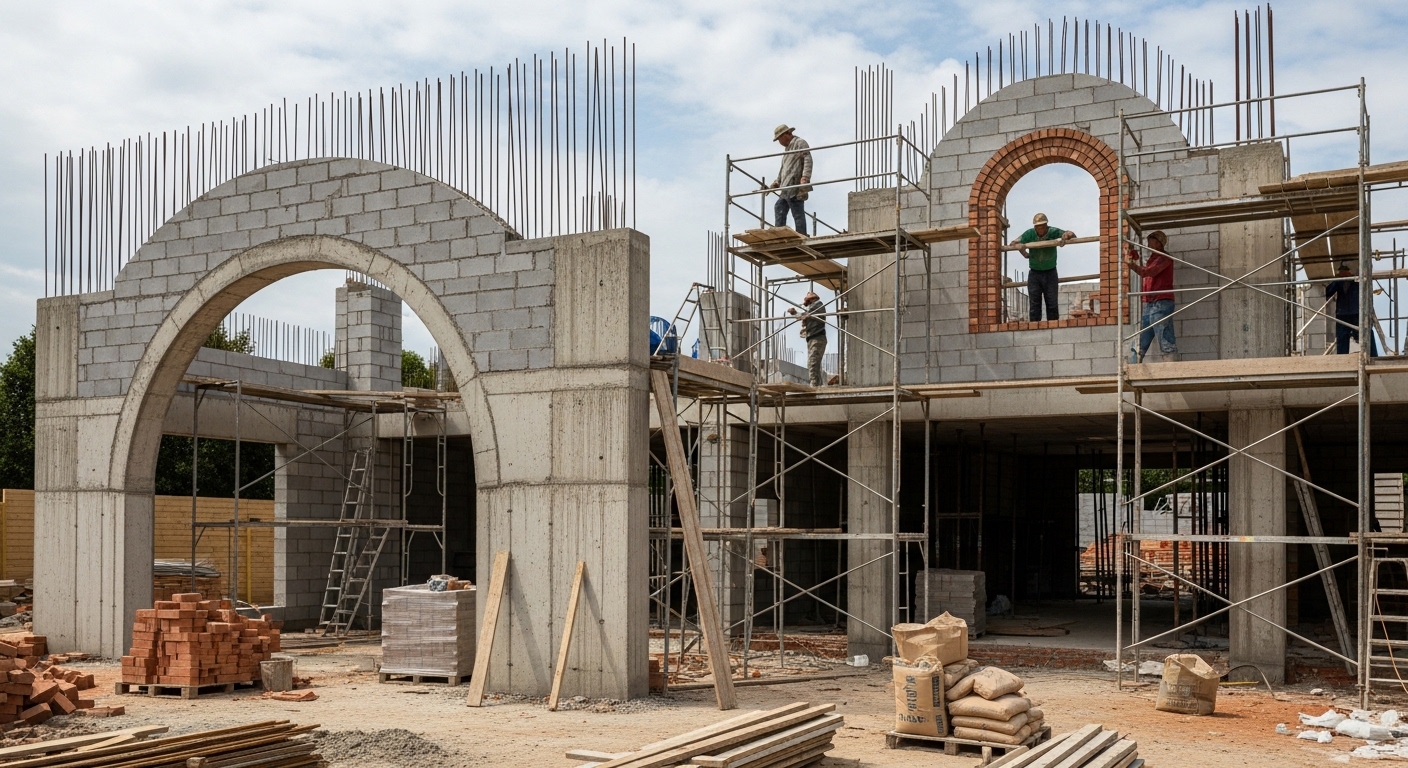
The keystone at the top locks the whole thing together. Each stone or brick in the arch pushes against the ones next to it, and the whole structure holds itself in place through that mutual pressure. No metal reinforcement needed. What does an arch look like when it’s working correctly? It looks like nothing is holding it up – which is exactly the point.
This is why arches appear in ancient Roman aqueducts, medieval cathedrals, and modern highway bridges. The geometry does the structural work.
Understanding Arch Shape and Structural Performance
The arch shape isn’t just an aesthetic choice – it directly determines how the structure behaves under load. A flatter arch spreads more horizontal force outward to the supports. A steeper arch exerts greater downward force. Get the geometry right for the materials and the span, and you get a structure that’s both strong and efficient. Get it wrong, and the supporters have to work much harder than they should.
Three general patterns matter most:
- Flat or shallow curves work for wide spans but require very strong supports to handle the outward push
- Steep curves carry more vertical load and put less stress on the sides – better for tall, narrow openings
- Parabolic shapes distribute force most evenly along the curve, which is why they appear in long-span bridges
The arch shape also determines how much height the opening needs. That trade-off between span and rise has driven the development of most of the arch types we still use today.
Main Types of Arches in Architecture
The types of arches in architecture that actually get used in practice come down to a handful of proven forms. Each one developed in response to specific problems – available materials, structural requirements, wall height, and the width of the opening. Here’s how they differ:
Semicircular (Roman) Arch
The simplest and oldest of the types of arches is exactly half a circle. The geometry makes force distribution predictable and even, which is why Roman engineers used it for everything from small doorways to massive aqueducts. The Pont du Gard in southern France is a well-preserved example that has stood for nearly 2,000 years. It’s not subtle or flexible, but it works reliably in stone and brick without any metal.
Segmental Arch
A shallower curve than the semicircular – less than half a circle. Builders developed this form when they needed to span an opening without adding much height above it. The lower rise means more outward push on the supports, but in exchange, you get a more compact opening. Common in residential buildings, older bridges, and other areas where headroom above an opening is limited.
Pointed (Gothic) Arch
The defining arch shape of medieval European cathedrals. Two curves meet at a point at the top. The pointed form directs the load more vertically than a round arch, reducing the lateral pressure on walls. That’s what made it possible to build the enormous stained-glass windows of Gothic churches – less wall was needed to resist lateral force, leaving more room for glass. The Notre-Dame Cathedral in Paris is the most recognizable example.
Horseshoe Arch
The curve here extends below the level of the supports – wrapping inward rather than stopping at the wall. Developed in Islamic architecture and found throughout the Middle East and Spain, the horseshoe arch architecture creates a sense of enclosure that other forms don’t. The Mezquita in Córdoba uses hundreds of them. Structurally, it behaves similarly to a semicircular arch, but the visual effect is completely different.
Elliptical Arch
Flatter and more elongated than a semicircle, the elliptical arch spans wide distances without requiring much height. The smooth curve distributes load fairly evenly and gives a lighter, more horizontal appearance than Roman or Gothic forms. Common in bridges, tunnels, and large interior spaces where a dramatic height isn’t wanted.
Famous Examples of Arches in Architecture
The examples of arches that most people recognize aren’t just architectural landmarks – they’re demonstrations of what the form can do at scale:
- The Colosseum, Rome. The exterior is built from stacked semicircular arcades – tier after tier of Roman arches distributing the enormous weight of the structure down to the ground. One of the clearest examples of arches used as a primary structural system rather than decoration.
- Arc de Triomphe, Paris. A single monumental arch as a freestanding structure. The form itself is the building. At 50 meters tall, it’s a demonstration of how the types of arches in architecture, which started as practical engineering solutions, became cultural symbols.
- Sydney Harbour Bridge. A steel arch spanning 503 meters – the widest long-span bridge in the world. The parabolic arch shape carries the load of the suspended roadway deck. Modern materials, ancient geometry. More on the engineering at Sydney Harbour Bridge’s official site.
What all three have in common is that the arch isn’t decorative – it’s doing structural work. That’s been true since Roman engineers first figured out the geometry, and it’s still true in every bridge, tunnel, and vaulted ceiling being built today.At Cypress Environment & Infrastructure, structural and civil engineering decisions – including choices about spanning systems and load paths – are always made in concert with environmental and site constraints. The most elegant engineering solution is only useful if it works with the land it sits on.