
Some bridges you drive across without thinking twice. Others you stop and stare at. Suspension bridges tend to fall into the second category – partly because of how they look, but mostly because of what they’re doing. Holding up thousands of tons of road and traffic across gaps that no other bridge type could realistically cross, using nothing but steel cables and carefully calculated tension.
They’re one of the most recognizable structures in engineering, and for good reason. Understanding how they actually work makes them even more impressive.
How a Suspension Bridge Works
The basic idea behind a suspension bridge is simpler than it looks. Instead of pushing weight down into the ground through solid columns under the road, the road hangs from cables stretched overhead. Those cables run from one end of the bridge to the other, passing over tall towers and anchoring into massive concrete blocks on both shores.
When traffic crosses, the weight pulls down on vertical cables hanging from the main cables above. Those vertical cables transfer the load upward into the main cables, which carry it outward to the towers and then down into the anchor blocks on land. The whole system works in tension – everything is being pulled, not pushed.
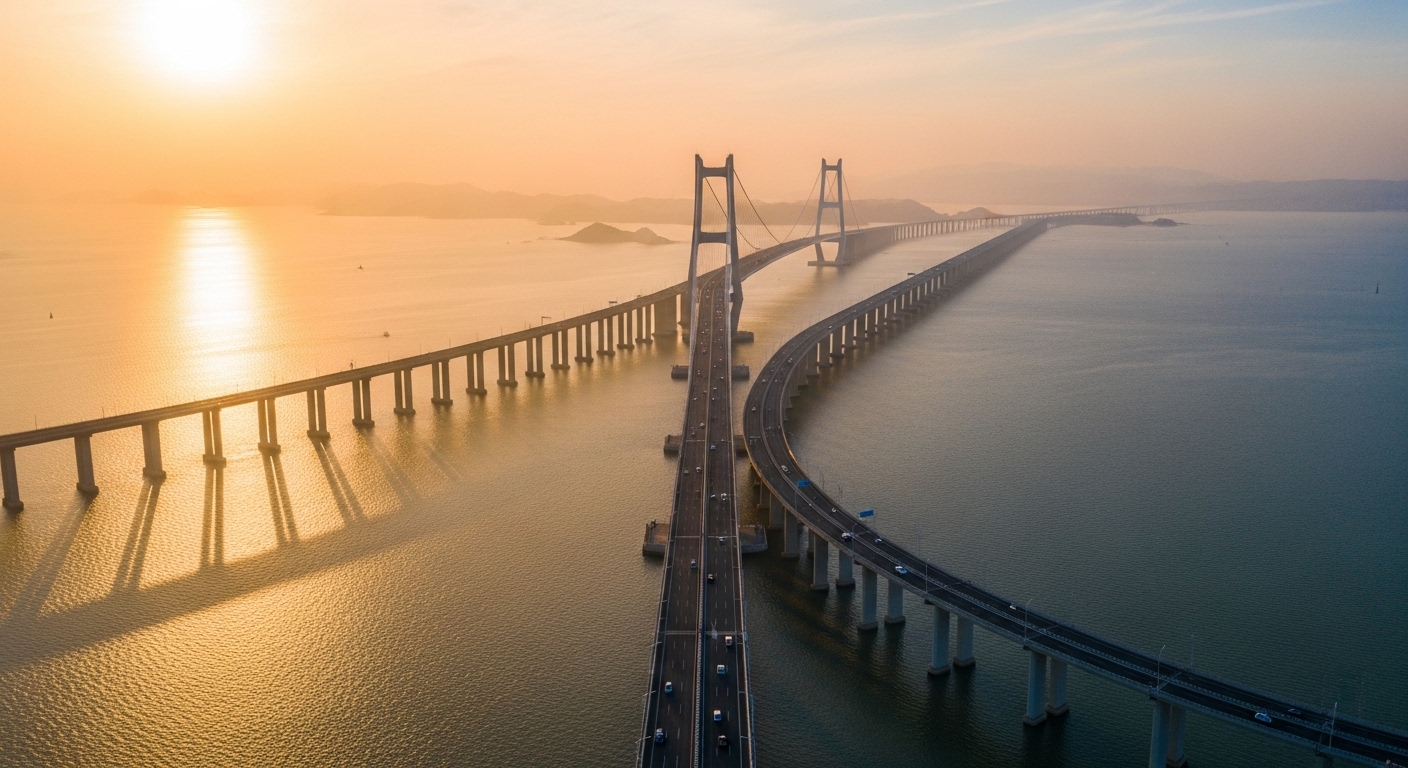
Here’s what each part actually does:
- Towers. These carry the main cables and transfer their load straight down into the ground. The taller the towers, the longer the span can be.
- Main cables. Thick bundles of steel wire run the full length of the bridge. They take on most of the weight and are under constant tension.
- Vertical suspenders. Thinner cables hanging down from the main cables, holding up the road deck at regular intervals.
- Road deck. The flat surface cars drive on, designed to distribute the traffic load across all the suspenders evenly.
- Anchor blocks. Huge concrete structures at each end hold the main cables in place, resisting a constant outward pull.
The reason suspension bridges can span such long distances is that this system distributes the load so efficiently. There’s no need for supports in the middle of the crossing – which is why they work so well over deep water, wide rivers, and valleys where building foundations in the middle would be impossible.
Engineering Principles Behind Long Spans
Building a suspension bridge across a few hundred meters is complicated enough. Pushing that span past a kilometer requires solving a different set of problems entirely.
- Cable shape. The curve of the main cables determines how efficiently they transfer load to the towers. Get the geometry wrong, and the forces don’t distribute evenly, putting dangerous stress on certain parts of the structure.
- Wind. Long, flexible spans can start to oscillate in the wind. The Tacoma Narrows Bridge collapsed in 1940 after wind-induced vibrations tore it apart – a failure that changed bridge engineering permanently. Every modern suspension bridge has been designed with aerodynamics in mind and tested in wind tunnels before construction begins.
- Flexibility vs. stiffness. A bridge that’s too rigid will crack under stress. One that’s too flexible will sway dangerously. Engineers balance these forces through road deck design and damping systems that absorb vibration.
- Seismic design. In earthquake-prone areas, bridges need to move with the ground without falling apart. This adds real complexity to the design process.
- Material quality. Modern high-strength steel can handle forces that would have been unmanageable with older materials, which is a big part of why suspension bridge examples from recent decades span distances that would have seemed unrealistic a century ago.
The Longest Suspension Bridge in the World
What is the longest suspension bridge in the world? That title currently belongs to the 1915 Çanakkale Bridge in Turkey, which opened in 2022 with a main span of 2,023 meters. The number was deliberate – chosen to mark the centenary of the Turkish Republic, founded in 1923.
The bridge crosses the Dardanelles Strait between Europe and Asia. Its towers stand 318 meters tall, taller than the Eiffel Tower, and the structure is built to handle major earthquakes and extreme winds. The longest suspension bridge in the world title has changed hands several times over the decades, each new record pushing what engineers thought was possible a little further.
Famous Suspension Bridges Around the World
Some famous suspension bridges are known for breaking records. Others became iconic through a combination of location, timing, and design. The ones people actually recognize usually manage both.
Golden Gate Bridge – USA
Completed in 1937, the Golden Gate spans 1,280 meters across the entrance to San Francisco Bay. When it opened, it was the longest and tallest suspension bridge ever built. The orange-red paint, the fog, the setting – it became a cultural landmark as much as an engineering one, and it’s been influencing bridge design ever since.
Akashi Kaikyō Bridge – Japan
For over 25 years, this was the answer to the longest span question – 1,991 meters across the Akashi Strait. It was designed to survive a magnitude 8.5 earthquake and typhoon-force winds. The cables alone contain enough wire to circle the earth seven times.
Humber Bridge – United Kingdom
When it opened in 1981 with a main span of 1,410 meters, the Humber Bridge held the world record for 16 years. It connects Yorkshire and Lincolnshire across a wide estuary and remains one of the most elegant examples of suspension bridge design in Europe.
Tsing Ma Bridge – Hong Kong
Unusual among famous suspension bridges because it carries both road and rail traffic. Its 1,377-meter span is built to withstand typhoons, with an enclosed lower deck that protects trains when the upper road deck must close in extreme weather.
Brooklyn Bridge – USA
Completed in 1883, the Brooklyn Bridge was the first steel-wire suspension bridge ever built. Its 486-meter span looks modest by today’s standards, but the engineering was completely new at the time. It took 14 years to build and was considered nearly impossible. It remains one of the most historically significant suspension bridge examples anywhere in the world.
Modern Suspension Bridge Design and Innovation
Building a modern suspension bridge today looks very different from how it was done even 40 years ago. The core principles haven’t changed, but the tools, materials, and understanding have advanced considerably.
- Digital modeling. Before anything is built, engineers simulate how a bridge will behave under thousands of different load and weather scenarios. This lets them catch weak points and test design changes without building a physical prototype.
- Wind tunnel testing. Scale models of every major bridge design are tested in wind tunnels to detect potentially dangerous vibration patterns before steel is ordered.
- Real-time monitoring. Modern bridges are equipped with sensors that continuously monitor cable tension, deck movement, and structural stress. Engineers can spot problems developing long before they become visible.
- High-strength composites. Newer materials are lighter and stronger than traditional steel, allowing longer spans with less total weight.
- Seismic isolation systems. In active fault zones, bridges are now designed with components that absorb earthquake energy rather than transmitting it directly into the structure.
Challenges in Building and Maintaining Large Suspension Bridges
Large suspension bridges almost always cross water – rivers, straits, bays. That creates a specific set of challenges that go well beyond structural engineering.
Working over or near water means dealing with environmental regulations from the start. In the United States, any construction that affects navigable waterways, wetlands, or coastal areas requires permits under the Clean Water Act, coordinated through the Army Corps of Engineers. Before a single anchor block is poured, the project team needs environmental assessments, wetland surveys, and documentation showing the project meets federal and state standards.
This is where firms like Cypress Environment & Infrastructure come in. Before bridge and infrastructure projects break ground near water or sensitive coastal areas across the Gulf Coast, the Cypress team handles the environmental groundwork – water flow modeling, impact assessments, permit preparation, and regulatory coordination. Getting that work done properly at the start prevents the kind of delays that can cost a project months and significant money.
Beyond permitting, the long-term maintenance of large suspension bridges comes with its own challenges:
- Corrosion. The main cables on a suspension bridge are under constant tension and exposed to the weather. Moisture gets into cable bundles over time, corroding individual wires. Regular inspection and protective systems slow the process, but cable maintenance is one of the highest ongoing costs for any large bridge.
- Expansion joints. The road deck expands and contracts with temperature changes. The joints that accommodate this movement wear out and need to be replaced regularly.
- Traffic growth. Many older famous suspension bridges were designed for traffic volumes that have since been far exceeded. Retrofitting them for modern loads – while keeping them open – requires careful engineering and significant investment.
- Monitoring systems. Keeping tabs on the condition of a structure spanning over a kilometer, in all weather conditions, requires continuous sensor networks and the expertise to interpret their reports.
The combination of technical complexity, environmental sensitivity, and long design life makes large suspension bridge projects some of the most demanding in civil engineering. The ones that get it right – from environmental review through construction through long-term maintenance – tend to last well over a century. The Golden Gate Bridge is approaching 90 years old and still carries over 10 million vehicles a year.