
Building a new structure is an exciting project. Whether it’s a small home or a large commercial complex, everyone wants the building to be safe, durable, and affordable. But the most important part of any structure isn’t what you see above the ground – it’s what’s underneath. This is where soil investigation comes in.
Soil investigation is a critical first step for any construction project. It involves studying the soil and rock below the proposed building site to determine whether the ground can safely support the structure’s weight. The primary goal of soil testing is to ensure safety, but it also plays a crucial role in cost efficiency.
Many people view soil testing as an unnecessary expense, but it’s actually an investment that saves substantial money down the line. Imagine starting construction only to discover the soil is much weaker than expected. You would have to halt work, redesign the foundation, and purchase new, expensive materials – causing delays and massive cost overruns.
A proper geotechnical investigation is the best way to avoid major construction risks. This detailed study goes beyond simple soil sampling to examine factors like groundwater levels, the presence of bedrock, and potential hazards such as sinkholes or seismic activity that could affect construction engineering, inspection, and long-term performance.
Understanding Geotechnical Investigations. Why They Matter
A geotechnical investigation is a detailed study of the soil, rock, and groundwater conditions at a site. Its main purpose is to gather the data needed to design and build a safe and economical foundation. It answers key questions like:
- How strong is the soil?
- How much will the soil compress or settle under the building’s weight?
- Where is the water table located?
- Are there any contaminants or unusual conditions in the ground?
This data forms the backbone of foundation design. Without it, engineers would essentially be guessing, and a strong foundation is critical to a structure’s stability.
The geotechnical investigation process typically follows these steps:
- Site Reconnaissance. An engineer visits the site to assess the land, checking nearby structures and noting surface features such as existing slopes or water bodies.
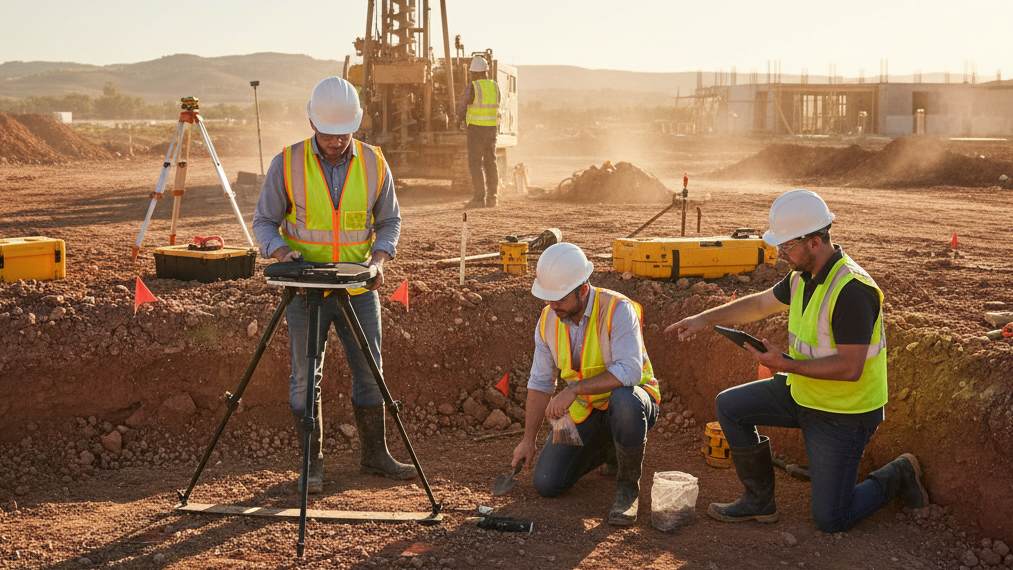
- Subsurface Exploration. This hands-on work involves drilling boreholes and digging test pits to access the layers of soil and rock below the surface.
- Soil and Rock Sampling. Samples of underground materials are carefully collected and transported to a lab for detailed testing.
- Laboratory Testing. Lab tests measure critical properties, including strength, moisture content, density, and compressibility.
- Engineering Analysis and Reporting. The engineer analyzes all field data and lab results to create a detailed report describing site conditions and providing specific design recommendations.
The insights gained from a geotechnical investigation provide long-term benefits, leading to a design that:
- Prevents Uneven Settlement. This stops the building from cracking over time.
- Avoids Foundation Failures. It ensures the ground can safely support the structure’s load.
- Optimizes Costs. By understanding ground conditions, engineers can avoid over-designing the foundation.
This planning ensures the project’s success not just during construction, but throughout the entire life of the building.
Types of Soil Testing and Their Applications in Construction
When samples arrive from the field, they undergo various geotechnical soil testing procedures. Each test reveals different critical data about the soil’s behavior. Common types of tests include:
- Sieve Analysis. Determines the size distribution of soil particles, helping classify the soil as sand, silt, or clay.
- Atterberg Limits. These tests measure the water content at which fine-grained soils change consistency – vital for determining clay’s strength and compressibility.
- Compaction Tests (Proctor Test). Determine the maximum density the soil can achieve, which is crucial for soils used as backfill or beneath pavements.
- Shear Strength Tests (Triaxial or Direct Shear). Perhaps the most important tests, these measure the soil’s ability to resist sliding or failure, directly impacting the bearing capacity of the foundation.
- Permeability Test. Measures how quickly water flows through the soil, which is important for drainage and dewatering plans.
Every geotechnical soil test serves a specific purpose. For example, shear strength tests ensure the foundation won’t punch through the soil, while compaction tests are necessary for retaining walls or roadway bases where dense, stable material is essential.
One specialized but crucial area is environmental soil sampling for contaminant analysis and remediation. If the site was previously used for industrial purposes or housed a gas station, testing for harmful substances like heavy metals or petroleum products is necessary before construction begins. This testing ensures worker and future occupant safety and informs the necessary site cleanup to meet environmental standards.
The results from soil testing for foundation analysis directly dictate the type of foundation used:
- When tests show strong, dense soil near the surface, a simple, cost-effective shallow foundation like a mat or spread footing is often the best choice.
- When tests reveal weak, highly compressible soil near the surface, a deep foundation becomes necessary, using piles or drilled shafts to transfer the building’s load to stronger soil or rock layers far below.
Accurate test results ensure the foundation will be effective without being overly large or costly.
The Process of Geotechnical Exploration: What You Need to Know
Geotechnical exploration is the comprehensive process of mapping underground conditions. It’s a systematic effort that moves from general observation to highly specific testing:
- Planning the Program. Based on the size and type of structure, an engineer determines how many boreholes are needed and how deep they should extend. Large buildings typically require numerous deep boreholes.
- Mobilizing Equipment. Specialized drilling rigs and vehicles are brought to the site. These machines can penetrate dense soil and rock.
- Borehole Drilling and Logging. As the drill descends, a geologist or engineer “logs” the hole, recording the depth at which different soil and rock layers are encountered and noting their color, consistency, and moisture content.
- In-Situ Testing. Certain tests are performed directly in the borehole. For example, the Standard Penetration Test (SPT) is a common in-situ test that measures the soil’s resistance to penetration, providing direct information about the soil’s density and strength.
- Groundwater Measurement. The groundwater level is measured, which is critical for construction planning.
Modern geotechnical exploration relies on various advanced tools:
- Drilling Rigs. The workhorses of exploration, using rotary or wash boring techniques to create boreholes.
- Sampler Tools. Equipment like Split-Spoon Samplers and Shelby Tubes is essential for gathering materials for laboratory analysis.
- Cone Penetration Test (CPT). A modern method where a cone is pushed into the soil, providing continuous data on soil strength and type without collecting physical samples.
- Geophysical Methods. Techniques like seismic surveys can map rock layers over large areas without drilling numerous holes.
The entire purpose of exploration is to ensure foundation integrity. By carefully mapping the subsurface, engineers can identify hidden pockets of weak soil, soft clay, or cavities that could cause structural collapse. This detailed subsurface map allows the design team to place the foundation’s load on the most reliable soil or rock layer available, transforming foundation design from guesswork into a fact-based engineering solution.
How Soil Testing Contributes to Safe and Stable Foundations
Soil testing is the first and most critical step in designing safe foundations. Since the structure’s weight must be safely supported by the ground, soil testing for foundation analysis provides the exact bearing capacity of the soil. If the soil can only support a certain load, the foundation must spread the building’s weight over a large enough area to stay below that limit, ensuring the soil isn’t overloaded and preventing catastrophic failure.
Several properties are key to ensuring a stable foundation:
- Shear Strength. The soil’s resistance to sliding failure. High shear strength indicates strong soil.
- Compressibility. Measures how much the soil will compress under load. High compressibility means the building will settle significantly, potentially causing damage.
- Moisture Content and Density. These interrelated properties indicate whether the soil is loose and waterlogged or dense and stable.
- Groundwater Level. A high water table can reduce soil strength and create buoyancy issues for the foundation.
Understanding these values allows engineers to predict how the building will behave throughout its lifetime.
There are countless examples where detailed soil testing for foundation changed entire projects. In one coastal city project, testing revealed a deep layer of soft marine clay. Without this testing, a simple, shallow foundation might have been constructed, leading to massive, immediate settlement and structural failure. Because of the test results, the engineer redesigned the foundation to use long concrete piles secured to stable bedrock hundreds of feet below. The initial testing cost was minimal compared to the expense of repairing a failed building.
The Cost Benefits of Proper Soil Investigation for Construction Projects
Proper soil testing is perhaps the most cost-effective component of any construction project. The money spent on investigation often saves ten times that amount during construction. By revealing potential problems early, a thorough soil investigation allows the design team to prevent:
- Excessive Excavation. Identifying rock layers early allows contractors to plan for specialized rock-breaking equipment only where needed, rather than encountering surprises during excavation.
- Dewatering Costs. When a high water table is identified early, engineers can plan efficient dewatering systems, avoiding emergency pumping costs when water floods the excavation.
- Construction Delays. Unexpected ground conditions are the leading cause of project delays. A comprehensive soil report eliminates these surprises.
The financial impact of skipping or inadequately performing soil investigation can be devastating. When unexpected soil conditions are discovered during construction, they lead to:
- Change Orders. Redesigning the foundation mid-project is expensive, requiring new contracts and materials.
- Litigation. When foundations fail or buildings settle excessively due to poor planning, project owners, designers, and contractors often end up in court.
- Repair Costs. Fixing a failed foundation on an existing building is incredibly expensive, often costing more than the original foundation.
Spending a small percentage of the total budget on detailed geotechnical soil testing is essentially insurance against financial disaster.
Ensuring Long-Term Structural Integrity: The Importance of Ground Investigation
The true value of thorough ground investigation extends far beyond the construction phase – it ensures the long-term structural integrity and durability of the building. A structure that rests on a properly assessed and designed foundation will require less maintenance and last its full intended lifespan, guaranteeing a stable investment.
Comprehensive ground investigation prevents structural issues that develop over time, including:
- Differential Settlement. Occurs when one part of the building settles more than another, causing cracks in walls, floors, and ceilings. Investigation identifies compressible soil layers, allowing engineers to design foundations that settle uniformly.
- Groundwater-Related Damage. Knowledge of the water table enables proper drainage and waterproofing measures, preventing water from corroding the foundation’s steel reinforcement or undermining the soil.
- Liquefaction Risk. In earthquake-prone areas, ground investigation tests for liquefaction potential – a condition where saturated soil temporarily loses strength during seismic activity. When risk is identified, special foundation techniques can mitigate it, protecting the structure during seismic events.
In conclusion, comprehensive ground investigation represents a commitment to quality and sound engineering practice. It ensures the structure is not only safe on opening day but remains safe and functional throughout its entire service life, maintaining its value and utility for decades to come.