
Someone planned the road outside your house. Someone calculated how many cars the bridge can hold before it needs to be replaced. Someone figured out why traffic on that one stretch of highway backs up every day at 5 pm, even when there’s no accident.
What is transportation engineering? It’s the branch of civil engineering that deals with moving people and goods by road, rail, transit, or air. It combines data analysis, structural design, and urban planning into a single discipline that most people never think about unless something breaks.
Transportation engineering services cover a project from start to finish: initial planning, technical design, construction oversight, and the maintenance phase that follows. Without this work, cities seize up. Roads fail ahead of schedule. Intersections that look fine on paper turn out to be dangerous in practice. The field also has to account for everyone using the road – not just cars, but cyclists, pedestrians, delivery trucks, and increasingly, autonomous vehicles sharing the same space.
Key Principles of Transportation Engineering
Move people safely. Move them efficiently. Don’t build something that works today but falls apart in fifteen years.
Transportation engineering depends heavily on modeling and data. A road gets designed not just for the cars using it now, but for projected traffic volumes two decades out. Engineers study what happens during peak hours – because a system that handles normal load but collapses during rush hour isn’t functional.
They also study behavior. A signal layout that’s technically optimal but confusing to drivers will cause accidents. The design has to be readable in real conditions, not just on a computer screen.
Four principles run through most projects:
- Safety – road geometry, sight lines, signal timing, and signage all affect accident rates. This one isn’t negotiable.
- Efficiency – reducing delay at intersections, shortening travel times, and keeping goods moving.
- Sustainability – systems that use less energy and create less long-term environmental damage.
- Capacity planning – getting the forecast right so infrastructure doesn’t become obsolete before it’s paid for.
Types of Transportation Engineering Services
Transportation engineering services are split into several distinct areas. Each one requires different tools, different data, and different expertise.
- Traffic Analysis and Planning:
Sensors, cameras, and historical data tell engineers how vehicles actually move through an area – where congestion forms, where it doesn’t, and why. From this, they make recommendations: retiming signals, adding a turn lane, and redesigning an interchange. Planning also includes demand management – strategies to spread travel demand across the day so infrastructure isn’t maxed out during the same two-hour window every morning.
- Pavement and Structural Design:
A road is multiple layers of engineered material. Engineers analyze the soil beneath the road, the climate the road will face, and the loads it must carry. Get the material selection wrong, and you’re repaving in five years instead of twenty. Get it right, and the road handles heavy trucks in summer heat and winter freeze cycles without constant repair.
- Public Transit Optimization:
Bus routes, train schedules, station layouts – all of these get designed and redesigned as cities change. Engineers use boarding and alighting data to find where service is thin and where it’s being duplicated. The goal is transit that’s fast and reliable enough that people choose it without being forced to.
- Intelligent Transportation Systems (ITS):
The technology side of transportation civil engineering. Adaptive signals that adjust to real-time traffic, electronic tolling, traffic management centers, and the communications layer that lets vehicles talk to infrastructure. ITS is why you can add vehicle capacity to a road network without physically widening the roads. It’s the software running underneath everything else.
Transportation Civil Engineering: Role and Responsibilities
Transportation civil engineering is the hands-on side – the engineers who take a design and make sure it can actually be built, and that it holds up after it is.
What that involves day to day:
- Surveying – before design starts, you need accurate data on terrain, existing utilities, soil conditions, and drainage patterns.
- Structural design – bridges, tunnels, and overpasses have load, wind, and, in some regions, seismic requirements. All of these get calculated before a beam gets placed.
- Construction-phase traffic control – when you’re rebuilding a highway, traffic still has to move. Designing that safely is a job in itself.
- Regulatory compliance – every project touches multiple regulatory layers. Federal safety standards, state environmental rules, and local codes. Missing one creates delays at best, liability at worst.
A transportation civil engineering engineer rarely works alone. Urban planners, architects, environmental scientists, and construction crews all have to coordinate. When something unexpected turns up mid-construction – bad soil, a utility conflict, a design that doesn’t translate to the field – engineers are the ones resolving it without stopping the project.
Environmental review is standard now. A highway through a wetland, a bridge over a sensitive waterway – these require impact assessments that take months. Engineers have to read and respond to those documents, and sometimes redesign around them.
Modern Solutions in Transportation Engineering
Adding lanes stopped being a solution a long time ago. In dense urban areas, there’s nowhere to put them, and research consistently shows that new capacity fills up quickly without actually reducing congestion. Transportation engineering solutions have moved toward getting more out of what already exists.
- Smart Traffic Management:
Static signal timers are being replaced by AI-driven systems that read actual traffic in real time and adjust accordingly. The practical result: less time sitting at a red light with no one coming from the other direction. Some systems tie into emergency dispatch – when an ambulance is heading somewhere, the lights ahead of it go green.
Before a project breaks ground, engineers build digital models of it. These let them test scenarios: what does traffic look like around a new stadium on game day? Where do evacuation routes fail during a flood? Transportation engineering solutions that get tested in software before construction avoid expensive real-world surprises.
- Sustainable Infrastructure:
Pavement design now includes materials that filter rainwater rather than sending it into storm drains. Rest stops are being built with EV charging infrastructure. Some asphalt mixes incorporate recycled rubber and plastic. These choices affect maintenance costs and service life, not just environmental metrics.
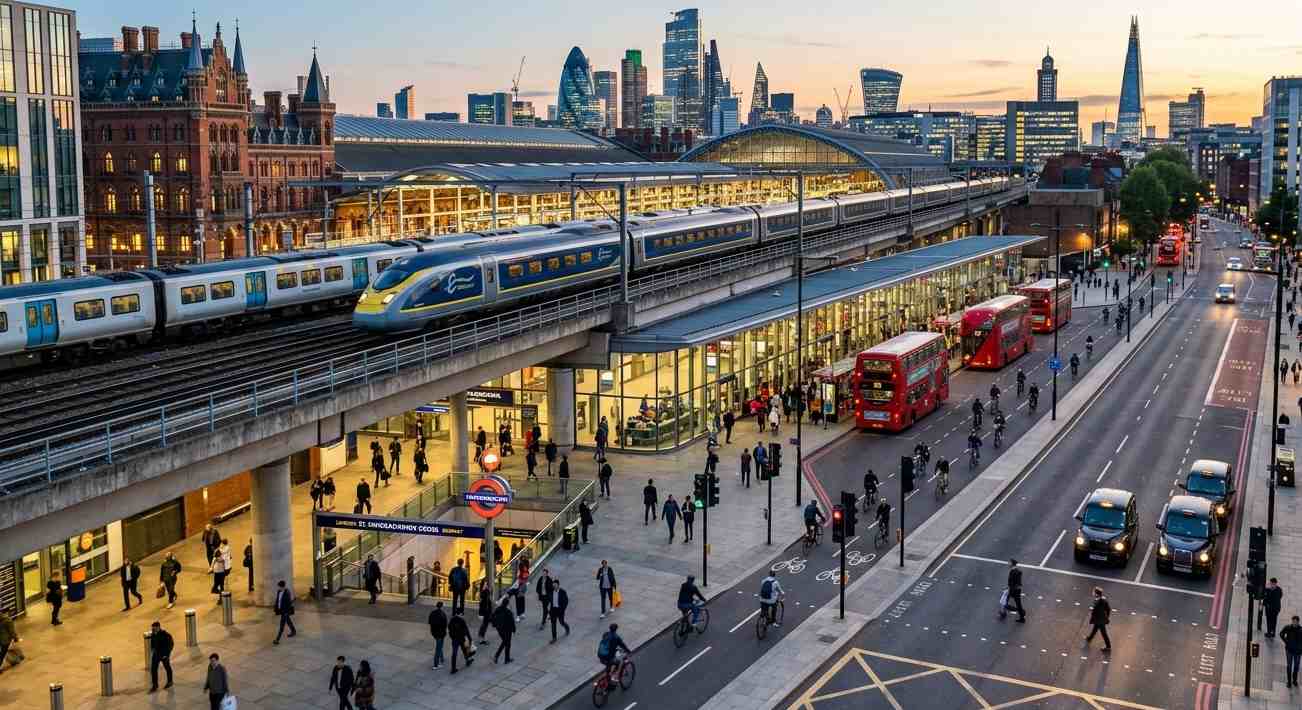
Why Transportation Engineering Matters: Benefits and Career Insights
Good transportation engineering services are invisible. When they work, you just get where you’re going. When they don’t, you notice – hours in traffic, goods arriving late, a bridge closing unexpectedly.
The effects go beyond inconvenience. Transit that reaches underserved neighborhoods connects people to jobs they couldn’t otherwise reach. Safe cycling infrastructure changes who can afford to commute. These are engineering decisions with social consequences.
For people considering the field: the work doesn’t stop. Infrastructure ages. Cities expand into areas that weren’t planned for. Climate conditions are changing the performance assumptions built into existing designs. There’s no shortage of things to fix or build.
Where people work:
- Government transportation agencies at the city, state, and federal levels
- Private consulting firms handling projects across jurisdictions
- International development organizations are building infrastructure in growing economies
- Logistics companies are optimizing delivery networks
The starting point is typically a civil engineering degree with a transportation concentration. AutoCAD, GIS, and traffic modeling software are practical skills worth having early. A Professional Engineer license eventually allows you to lead projects independently.
The next wave of problems in transportation engineering involves autonomous vehicles, urban air mobility, and infrastructure designed for a climate that’s already different from when most of what we drive on was built. The underlying skills – structural analysis, systems thinking, data interpretation – apply to all of it.
Cypress Engineering offers transportation, civil engineering, and consulting across planning, design, and analysis. Reach out to talk through what your project needs.