
A dock or pier on the Gulf Coast is a small structure with a long permit shadow. Navigable waters, wetlands at the landward edge, coastal program rules, local building and setback ordinances, and sometimes submerged-lands leases all show up before the first pile is driven.
Cypress Environment & Infrastructure designs and permits waterfront access structures for public and private clients in our region — marshwalks, piers, and related shoreline work included. This page is the practical stack, not a catalog of pile sizes.
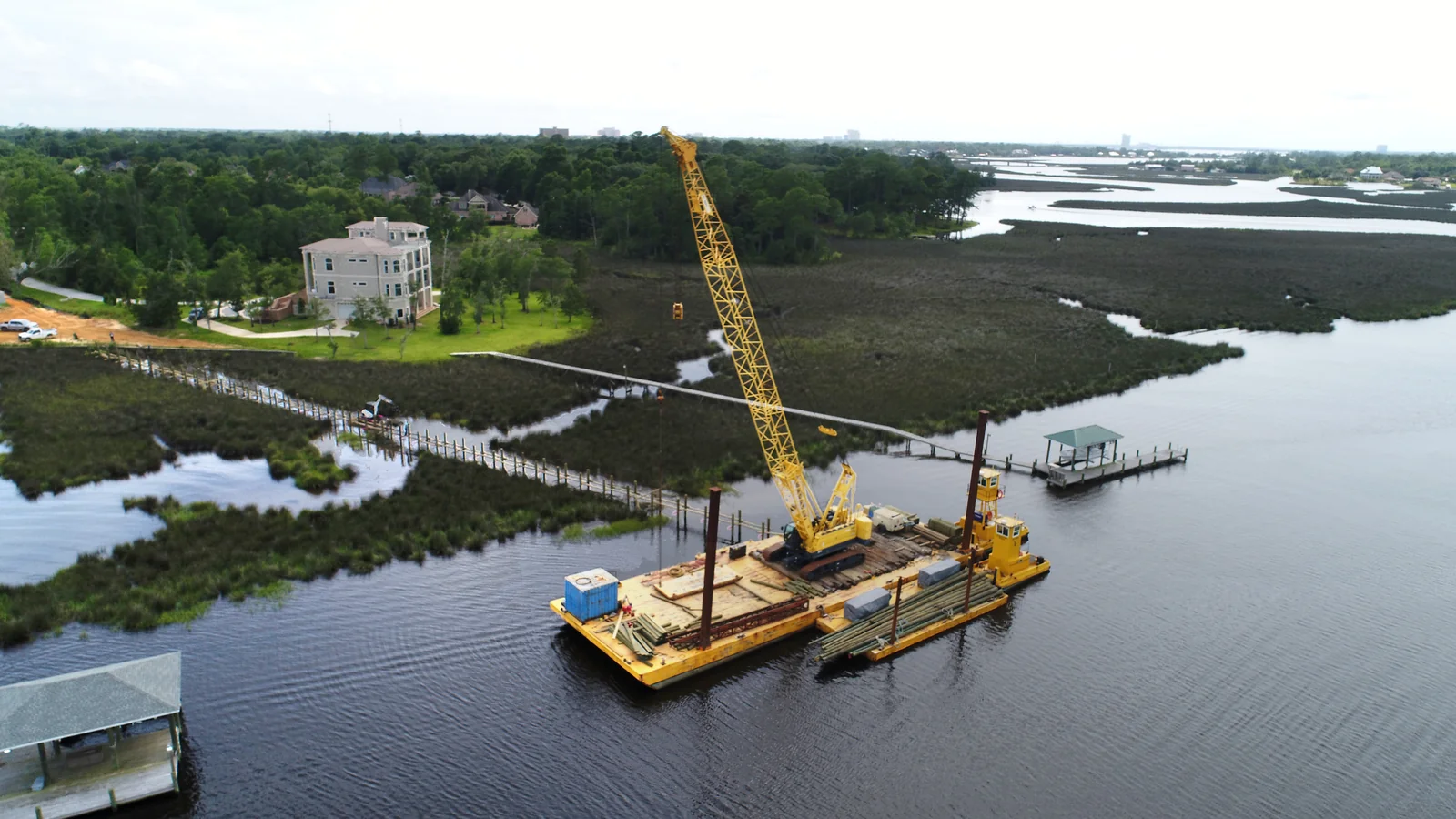
What usually triggers review
Most fixed or floating docks, piers, boat lifts, and marshwalks in tidal or navigable waters need some combination of:
- Section 10 (Rivers and Harbors Act) authorization from the Corps for structures in navigable waters of the United States
- Section 404 if the work discharges dredged or fill material (approach fill, abutment, shoreline tie-in, dredging for access)
- State coastal / ERP / water-quality approval or consistency depending on MS, AL, or FL rules
- Local building permit, dock ordinance, HOA covenants, and floodplain requirements
- Submerged lands / riparian issues where the state owns the bottom or riparian rights limit length and location
A “small residential dock” is not automatically exempt. Exemptions and general permits exist; they are narrow and fact-specific. Read the current regional general permit and state form for your waterbody instead of relying on what the neighbor built in 1998.
Federal review process (when it applies)
For small projects that fall under typical residential construction thresholds, the Federal review is minor and even conducted by the State permitting agencies on behalf of the Corps of Engineers under General Permits.
Corps review looks at navigation, public interest factors, and aquatic impacts. General permits can cover routine single-family docks that meet dimensional and location limits. Individual permits show up for larger marinas, commercial piers, dredging packages, or work that falls outside general-permit boxes.
Related structures — boat houses, lifts, breakwater structures, and fuel docks — change the analysis. So does work next to federal channels or civil works, which can pull Section 408 and US Coast Guard reviews alongside Section 10/404.
State and coastal processes
Mississippi (coastal counties). DMR coastal wetlands / consistency and MDEQ 401 often coordinate with the Corps package in Hancock, Harrison, and Jackson Counties. Inland docks on non-coastal waters follow a different state path.
Alabama. ADEM 401 and, where the coastal area applies (Baldwin/Mobile seaward of the continuous 10-ft contour), Division 8 coastal review. Length, setbacks from channels, and water-bottom impacts matter.
Florida. ERP covers a large share of dock and pier work in wetlands and surface waters; CZM consistency is often carried through that ERP action. Local governments and water management districts add detail. CCCL and coastal construction rules can apply on Gulf-front parcels even when the “dock” conversation started as a backyard pier on the bay side.
See coastal zone management and state water quality and coastal permits.
Design choices that change the permit
- Length and navigation setbacks. Encroaching on a channel or blocking neighbors’ riparian access kills otherwise simple packages.
- Pile vs floating. Wave climate, depth, and seagrass / resource concerns drive both structure type and impact narrative.
- Shoreline tie-in. Bulkhead returns, abutments, and approach fill are where 404 and coastal wetland impacts often occur, triggering the need for more involved fill permits.
- Lighting, roofs, and enclosed structures. Local codes and coastal aesthetics rules escalate quickly.
- Dredging. Access dredging is a different project than dock work, but may be included in combined permits for some mix of piers, decks, dredging, bulkheads, boat ramps and other water access improvements.
- Living shorelines and low-impact shoreline armoring. Soft armor or marsh plantings beside piers and other coastal structures can help — or add scope. See living shorelines.
Public vs private
Municipal / park piers and marshwalks need the same federal/state stack plus procurement, accessibility, and maintenance funding. Public access goals help the public-interest story; they do not erase resource impacts and typically require more intensive Individual Permits.
Private residential docks need early HOA and local ordinance checks. Many Gulf subdivisions have stricter private rules than the state minimum.
Cypress has delivered pier and marshwalk design in the region (including dozens of private piers as well as public park work documented on our projects pages).
Process and schedule
- Confirm riparian / ownership and local dock rules
- Screen resources (wetlands, SAV, oysters, cultural) at the right level for the permit path
- Pick general vs individual permit strategy with dimensions that fit
- Align state coastal / ERP / 401 with the federal package
- Engineer the structure for wind, wave, vessel load, and constructability
- Build conditions into the drawings (turbidity, work windows, pile methods)
Skipping to shop drawings before step 1 is how piles get ordered for a footprint the agency will not authorize.
Other considerations for more ambitious projects
- Structural pile schedule or wind-load spreadsheet
- Marina master-planning
- Mitigation credits or other resource fees
- Grandfathered structures on adjacent properties may not be an indicator of what can be built today
How Cypress works docks and piers
We integrate civil/structural waterfront design with environmental permitting so the deck length, pile layout, and shoreline tie-in match what the agencies will accept. City engineers and private clients get candor on whether a general permit is realistic or whether the planned work is really an individual-permit job.
Cypress Environment & Infrastructure works from offices in Biloxi, Mobile, and Pensacola. Licensed in Mississippi, Alabama, Florida, Louisiana, and Georgia. Office hours Monday–Friday, 9 a.m.–5 p.m.
Questions about your project? Contact Cypress Environment & Infrastructure or call 228-596-1580.
See civil coastal engineering and projects.