
A living shoreline uses plants, sand, oyster or other reef structure, and selective sill or breakwater elements to add stability and erosion resistance to a shore while maintaining a more natural shoreline condition. It is an alternative to a continuous bulkhead or seawall when the wave conditions, fetch, boat traffic, sediments and land use allow it.
Cities and private waterfront owners in our region ask the same practical questions: Will it hold? What permits? How much maintenance after the ribbon cutting? Cypress Environment & Infrastructure answers those with civil and coastal engineering design plus environmental permitting.
What “living shoreline” means here
On the Gulf Coast, living shorelines commonly mix:
- Sills, coir, or rock toes to provide the essential structure and stabilize the edge at its highest stress points
- Marsh plantings and graded slopes that dissipate energy
- Oyster reef or precast reef blocks or similar low-profile breakwaters offshore of the planting zone
- Sediment placement where the profile needs sand or sediment before vegetation will take
All of this has to be carefully engineered to ensure success. Slope, toe protection, wave climate, boat wakes, and tidal ranges matter more, not less for living shorelines. A living shoreline that is too green or ignores fetch is a temporary garden.
Bulkheads remain appropriate in high-energy or constrained urban edges where upland structures, navigation, or existing armor leave no room for a soft profile. The core question is site suitability.
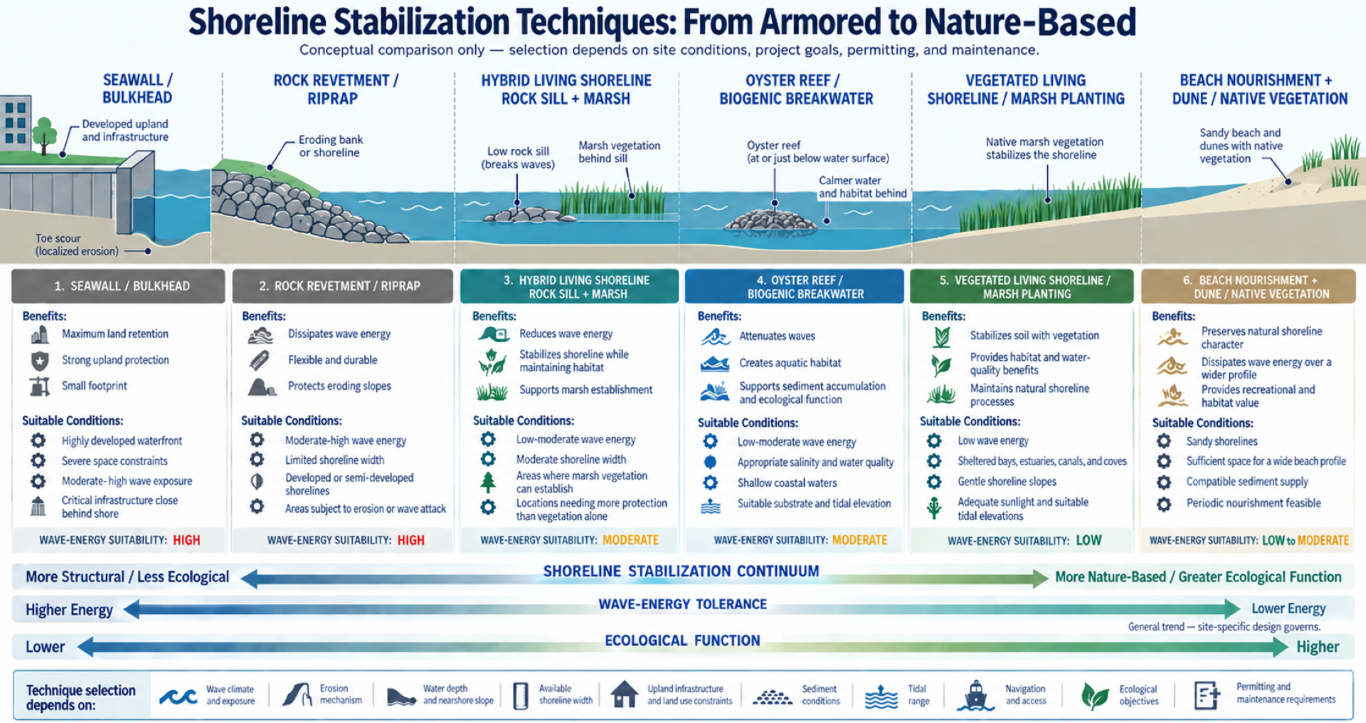
- Spectrum of shoreline protection options: seawall/bulkhead → riprap / revetment → hybrid sill + marsh → oyster reef → vegetated living shoreline → beach + dune
- Benefits and suitable conditions vary by fetch and site; site-specific design governs
Who this is for
Municipalities and ports — park shorelines, public access edges, marshwalk approaches, and places where a vertical wall fights every storm and loses public trust. Pair with green infrastructure inland so the shore is not the only BMP. Cypress has delivered living shoreline and marsh restoration work in the region. See projects.
Private waterfront owners — residential and light commercial parcels where a failing bulkhead or eroding lawn meets a bayou, sound, or lagoon with moderate energy. HOA and municipal rules often matter as much as the water.
Hybrid sites — pocket beaches, marsh edges next to a short return wall, or reef-sill systems in front of limited armor. Most successful Gulf jobs are hybrids.
Design drivers that decide yes / no / hybrid
- Wave energy and fetch. Open bay and sound fetch is not the same as a sheltered bayou. Instrument data or a defensible coastal analysis is necessary. Modeling is typical for ports, marinas, and large municipal projects. Most residential design requires less analysis.
- Boat wake and navigation. Channels and marinas change the energy regime that softer structures must be designed for.
- Tidal range, salinity, and substrate. Planting zones fail when the mud cannot hold roots or the salinity regime was misread.
- Upland constraints. Wetland lines, structures, utilities, and property lines limit how far landward you can grade.
- Maintenance capacity. Cities need a mow/plant/debris plan. Private owners need a maintenance schedule and contractors who can provide periodic upkeep.
- Adjacent armor. A soft edge between two bulkheads can scour at the transitions if returns and flank protection are ignored.
Permitting stack (high level)
Living shorelines are not “exempt because they are green.” Typical paths in our region can include:
- Corps Section 10 / Section 404 authorization when work is in navigable waters or involves discharge of dredged or fill material (reef material, sand, sill rock). Nationwide or regional general permits sometimes fit; sometimes they do not.
- State coastal / water-quality programs — Mississippi coastal wetlands and consistency, Alabama coastal Division 8 where the coastal area applies, Florida ERP and related coastal review. See state water quality and coastal permits and coastal zone management.
- Local building, dock, and setback rules; some cities have living-shoreline incentives or bulkhead restrictions.
Sequence matters. Planting plans without fill/structures authorization are incomplete packages.
Living shoreline vs bulkhead (practical)
| Factor | Living shoreline / hybrid | Continuous bulkhead |
|---|---|---|
| Energy | Best in low–moderate fetch; hybrids for more | High energy / tight urban edge |
| Habitat & water quality | Higher potential lift | Lower; reflective waves can scour toe |
| Footprint | Needs width for slope / sill | Narrower horizontal footprint |
| Maintenance | Vegetation, debris, storm repair | Armor repair, tie-back / corrosion issues |
| Permitting | Often more agencies (still fill/structures), but expedited GPs increasingly available as an incentive. | Familiar but increasingly scrutinized |
Neither is “free of permits.” Neither is maintenance-free.
Civil and environmental roles
Cypress’s work on these projects is a hybrid by nature: grading and structure sizing (civil / coastal), planting and resource assessment (environmental), and a permit package that matches both. Keep civil visible — the sill and profile are what keep the planting alive. Keep environmental honest — the resource claim has to match what you build.
How we ensure living shorelines succeed
We screen energy and constraints early, sketch hybrid options when a pure soft edge will not hold, and build the permit path beside the design — not after the contractor is mobilized. City engineers and private clients get the same candor: if a bulkhead is the only thing that protects the house, we say so.
Cypress Environment & Infrastructure works from offices in Biloxi, Mobile, and Pensacola. Licensed in Mississippi, Alabama, Florida, Louisiana, and Georgia. Office hours Monday–Friday, 9 a.m.–5 p.m.
Questions about a Gulf living shoreline, bulkhead, or other protection structure? Talk with Cypress Environment & Infrastructure — Contact us.
See civil coastal engineering, green infrastructure, and projects. This page is not site-specific design criteria – all sites have unique combinations of conditions.